Polish-language education and resistance to Russian-language schools
The PeasantsPolish-language education and resistance to Russian-language schools in The Peasants bring national identity into the everyday business of a village meeting. The conflict is not simply between education and ignorance: Antek Boryna says that Lipce needs a school, while refusing to approve money for the Prefect’s proposal. The villagers’ demand is that children learn in their own tongue. Their resistance makes language a question of political standing: who may decide what the village learns, what it must pay, and whose words count as law.
Historical and Political Stakes
The school dispute carries a history larger than Lipce. In the Russian partition, peasants had been bound to landowners by unpaid labor before serfdom was abolished in 1864; after emancipation, the challenge of building a national identity among former serfs remained unresolved. Polish political thinkers regarded peasant national consciousness as essential to the possibility of a strong, independent Poland. The novel’s village therefore matters not only as a rural community but as a test of whether peasants can become participants in a wider Polish political community.
The novel places that question in material circumstances rather than treating national identity as an abstraction. The villagers’ claims grow out of experience with officials, taxes, and decisions made over their heads. The school proposal arrives through administrative authority, and the villagers are asked to pay for a plan they have not shaped. Their opposition links the language of belonging to the distribution of power: being addressed in a language they do not understand makes the official proceeding itself a form of exclusion.
A School Proposed, and a Village Divided
The issue first emerges in a conversation among younger villagers. Rocho reports that the Prefect has said Lipce’s people must gather in two weeks to approve a school. Płoszka dismisses the question as something for the elders, but Grzela rebukes the young men for leaving public affairs to their fathers. His intervention makes participation itself part of the dispute: the future of the village, he insists, cannot be left entirely to the older generation.
Antek gives the debate its defining distinction. He agrees that Lipce needs a school but says that the villagers should not approve even a grosz for the Prefect’s school. Rocho supports resistance and warns that a small assessment may grow: approve a zloty, he argues, and it may become a rouble. He invokes the earlier courthouse resolution, saying that those who collected the village’s money had profited from it. His argument joins language and taxation to a broader suspicion that official promises of public benefit can become another demand on village resources.
Rocho also works quietly to build opposition. He takes Grzela aside, gives him pamphlets and small books, and instructs him gravely. The organizing is not confined to a single speech or to the formal meeting: printed material and discussion help carry the question into the village’s own networks. Yet the young men do not speak with one voice. Their arguments reveal both a developing sense of shared responsibility and uncertainty about whether resistance can protect the community from official consequences.
The Assembly and the Demand for Their Own Tongue
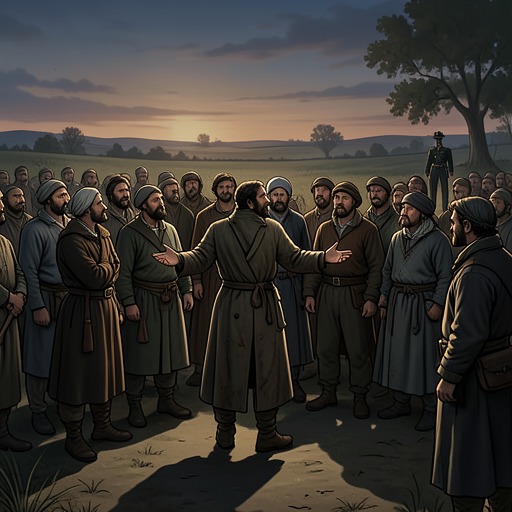
At the meeting, the proposed school is presented as an administrative order for Lipce and neighboring villages, including Modlica, Przyłęk, and Rzepki. The Notary reads the text slowly, but the villagers interrupt to say that they do not understand a word and demand that it be read in their tongue. The practical failure of communication becomes the political fact of the scene: the people expected to approve the plan cannot follow the language in which it is being explained.
The Notary describes the authorities as benevolent and says that the school will require a plot, a building, a teacher, and an additional tax of twenty kopecks per morgen. The official case therefore combines promises of instruction with a specific financial obligation. The proposed opening date—children might attend the following autumn if approval is given—does not remove the villagers’ central objection. The question is not whether schooling could be useful, but whether the community must accept an imposed arrangement and pay for it without being addressed in a language it understands.
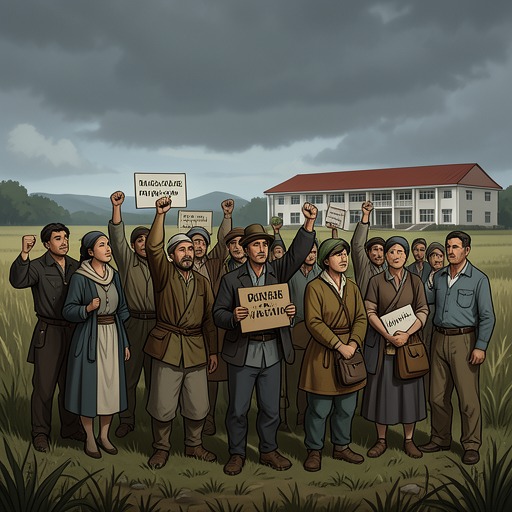
Grzela states the refusal directly: the villagers will not approve a single grosz for such a school. A hundred voices support him. When the Voyt calls the meeting to order, the crowd’s answer is not simply a counterproposal about costs. The villagers insist that learning in their own tongue is a condition of any school they will accept. The distinction matters: their protest is not a rejection of education, as Antek’s earlier statement makes clear, but a refusal to treat instruction administered in another language as an unquestionable public benefit.
Collective Resistance and Its Limits
The demand for their own tongue draws strength from the crowd’s shared presence. When the gendarmes are summoned, the peasants close around them, warning that there are three hundred people present and that no one should be touched. They then part to let the gendarmes through, only to surge after them in front of the Prefect. Their movement is collective but not an attack: they assert their numbers and press their grievance while confronting the officials in the open meeting.
Antek sharpens the challenge with mockery. He jokes that the authorities should order pigs to sing like larks or make a goose bellow, then says that the villagers might approve a school. He also invokes the tsar’s written decree, claiming that schools and courts are to be in Polish, and points to the papers on the table when the Prefect asks who he is. His defiant answer gives the protest a legal as well as a linguistic edge: Antek presents the villagers’ demand as consistent with a written authority, not merely as local insolence.
The exchange does not end in a secure victory. After the meeting’s arguments and quarrels, the Prefect cuts through the proceedings with an order that the school is to be approved. The crowd falls silent; fear replaces the noisy resistance, and the villagers stand as if turned to stone while officials urge obedience. The scene thus holds two realities together: the villagers have articulated a collective claim to language and participation, but the administrative power to compel them remains in place.
Significance
The school debate makes language a concrete measure of political inclusion. The villagers are asked to listen, understand, vote, and pay; when they cannot understand the text, the formal appearance of consent becomes suspect. Their demand that instruction be conducted in their tongue challenges a system in which official decisions can be imposed without meaningful comprehension or agreement.
At the same time, the episode is skeptical about the conversion of village solidarity into durable political agency. The assembly can refuse, surround the gendarmes, and answer official claims with its own reading of the written decree, yet a direct command from the Prefect still silences it. The resistance is real, but its outcome is unresolved in the scene: Lipce has found a public language for its grievance, while the authorities retain the power to force the decision. The school question therefore stages both the possibility and the fragility of peasant political consciousness.